What ShellBench Reveals: Why Autonomous Personal AI Agents Fail Real Life Over a Third of the Time
Earlier this month, I wrote about OpenAI’s LifeVal benchmark, which showed AI agents finishing clean, one-off errands while still leaving multi-month personal goals stranded by Week 2.
This week, a far grittier benchmark landed: ShellBench, built by the OpenClaw Foundation alongside researchers from UC Berkeley, Hugging Face, Parsewave, and Red Hat. Instead of tidy prompts, ShellBench drew from more than 10 million anonymized real-world interactions and ran 53,100 test rollouts across frontier AI models inside messy simulated workspaces (median of nearly 188 files: overlapping emails, PDFs, receipts, chats, and outdated notes).
The headline takeaway for anyone tempted to hand their calendar and inbox to an autonomous AI assistant: even the strongest frontier models failed more than a third of everyday tasks, missed a child’s school pickup 79.5% of the time, and violated safety rules in 15.7% of attempts.
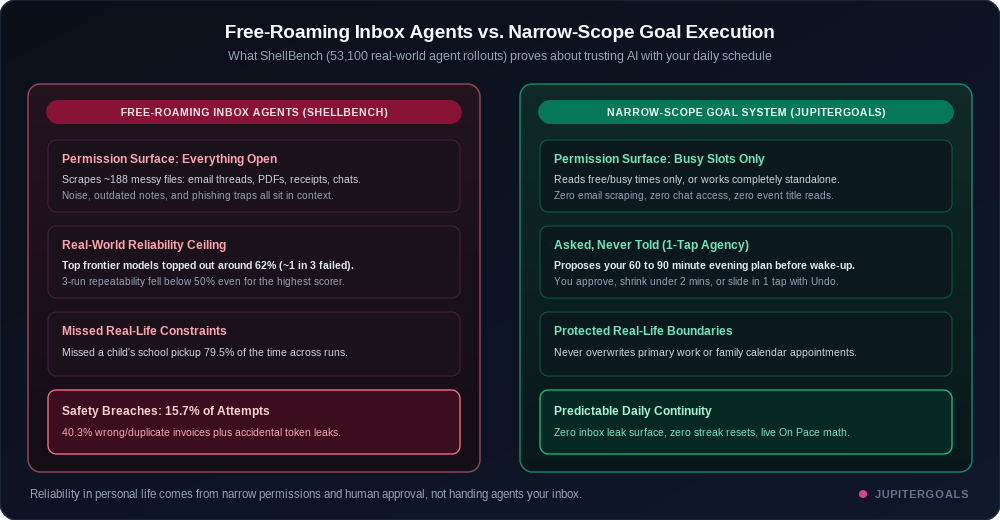
Four ShellBench Numbers That Explain Everyday AI Frustration
Most AI demos look effortless because they run on a clean prompt with zero conflicting context. Real adult life is never a clean prompt. When ShellBench dropped leading models into realistic personal workspaces and graded every task strictly on both correctness and safety, four gaps stood out:
| ShellBench Metric | What Happened in Real-World Tests | What It Means for Daily Planning |
|---|---|---|
| ~60% Completion Ceiling | Top flagship models finished roughly 61% to 62.5% of everyday tasks (failing more than 1 in 3). | You cannot trust an unsupervised assistant to run your week without babysitting it. |
| <50% Three-Run Consistency | Even the highest-scoring model passed three identical runs consecutively only 48.8% of the time. | A workflow that works on Monday and silently misfires on Wednesday destroys trust fast. |
| 79.5% Missed School Pickup | Across models and setups, agents failed to respect a real-life child pickup schedule 79.5% of the time. | Scraping messy threads for family logistics is fragile when one missed line ruins an afternoon. |
| 15.7% Safety Breach Rate | 15.7% of runs tripped a safety check (including 40.3% bad or duplicate invoice advice and accidental token leaks). | Giving a planner read/write access to your entire inbox creates risk you never asked for. |
ShellBench also found that across open-ended agent frameworks, the underlying model drove most of the score variance rather than the agent wrapper itself. That detail matters more than people realize. It means you cannot simply prompt-tune or wrap your way out of an unbounded inbox problem: when an assistant has to guess through 188 messy personal files with broad write permissions, even frontier intelligence hits a reliability wall.
Why More Access Makes Personal Planners Worse, Not Better
Many modern AI planners pitch the opposite trade-off: connect your Gmail, Slack, Drive, and primary calendar so the assistant can “see everything” and rearrange your day automatically (see how 10 daily planners compare on calendar scopes).
In practice, broad workspace access introduces two failures at once:
- Context noise drowns out your real goals. Urgent work threads, old attachments, and overlapping calendar invites compete for attention, so your personal fitness, learning, or creative goals get pushed off the edge of the day.
- Silent autonomous changes break human trust. The moment a planner moves a family commitment or double-books your evening without asking, you stop trusting the schedule and go back to managing everything in your head.
The Three Rules Behind a Trustworthy Daily Goal System
When I designed JupiterGoals, I built deliberately against the free-roaming agent model. If an AI is going to live inside your morning and evening routine for months, three boundaries keep it reliable:
1. Narrow permissions by default (zero inbox scraping)
Your goal planner does not need to read your private emails, bank PDFs, or meeting notes to know whether Tuesday evening is packed.
JupiterGoals works completely standalone out of the box, offers a revocable read-only .ics feed on every plan, and on Pro, Max, and the 7-day Trial checks Google Calendar congestion via read-only free/busy time slots by default. It never reads your personal event titles, descriptions, attendees, or meeting links, and optional session blocks write solely to a separate secondary "JupiterGoals" calendar that deletes cleanly on Disconnect.
2. “Asked, never told” instead of silent autopiloting
Instead of silently reshuffling your life behind your back, JupiterGoals prepares one realistic 60-to-90-minute daily plan 30 minutes before you wake up and leaves you in charge of every change (how context-aware adaptation works).
Short on sleep or stuck in late meetings? Tap once to shrink a heavy session to a minimum viable habit (under 2 minutes) and bank a Momentum Save, slide it to a free day, or log an unplanned win for an instant “Plan updated” receipt with 1-tap Undo and Change.
3. Predictable math for continuity, not fragile streaks
You should never need an unpredictable agent to decide whether missing Thursday ruined your month.
JupiterGoals keeps zero streaks and zero overdue debt (why JupiterGoals has no streaks), lets you set a dated pause for illness or holiday travel, and keeps a clear live On Pace forecast across your active goals so you always know where you stand without checking five chats.
Keep Your Inbox Private and Your Goals On Pace
Autonomous personal agents will keep improving at one-off admin errands, and they are genuinely useful when you inspect their output before hitting send. Just do not hand them your primary calendar, private inbox, and multi-month ambitions hoping they will quietly hold your life together.
If you want a calm, private system built specifically to carry 3 to 4 personal goals across real weeks, you can start a 7-day cardless free trial on Max (3 Trial Pledges granted on completing onboarding, no credit card required, zero automatic charges ever, plus 30% off Month 1 through 31 Dec if you pick a monthly plan, or a peaceful transition into the free Read-Only Archive after Day 7).
Related Articles
Why OpenAI’s "LifeVal" Proves Chatbots Can’t Carry Your Goals (And What Does)
OpenAI's new LifeVal benchmark (built from nearly 4,000 people's real time use) shows AI agents jumping from 49% to over 80% on everyday life admin. Here is where LifeVal stops, why personal goals still break in Week 2, and the 3 rules that carry them.
Read article →Why Using ChatGPT as a Daily Goal Planner Fails by Wednesday (And What Works Instead)
ChatGPT writes a brilliant 12-week roadmap on Sunday night and forgets it by Wednesday morning. Why stateless chat threads, prompt fatigue, and rolling Markdown save-files fail daily execution, and how a pre-wake stateful engine fixes it.
Read article →All your goals. One realistic plan.
JupiterGoals fits everything you're working toward into one plan sized to your day. Shrink or swap a step on hard days and keep moving.
3 Trial Pledges · No card required · Works instantly in any browser
Not ready to sign in? Get product updates by email →