Why OpenAI’s "LifeVal" Proves Chatbots Can’t Carry Your Goals (And What Does)
OpenAI just released LifeVal, a new benchmark built around a question millions of ChatGPT users have been asking quietly: can AI actually help with real everyday life, not just coding and math?
To build LifeVal, OpenAI combined real human time-use data with a survey of nearly 4,000 people on where everyday help matters most: household admin, budgeting, childcare research, caregiving plans, and paperwork. Across recent GPT generations, AI completion scores on those multi-step tasks jumped from roughly half (49.3%) to over 80% (80.6%).
That jump explains why giving an AI two jobs on Sunday night feels magical at 9 PM and broken nine days later:
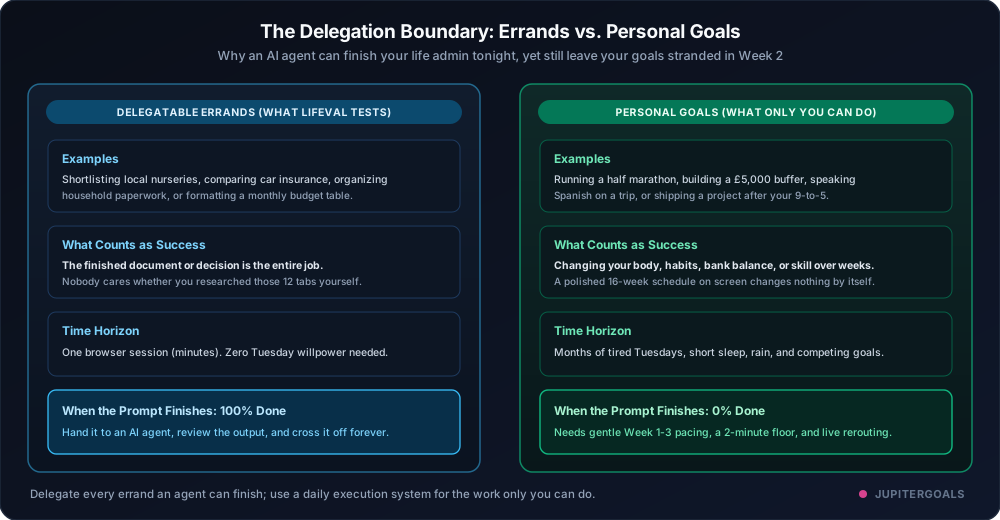
- Ask an agent to compare three local nurseries and put the fees in a table, and by 9:15 PM the job is genuinely finished.
- Ask it for a five-month plan to run a half marathon and save £5,000, and by next Wednesday the plan is dead in your chat history.
LifeVal proves AI agents are getting remarkably good at errands you can delegate, and by doing so, it exposes the exact boundary where chatbots fail: goals that require you to show up.
What OpenAI’s LifeVal Gets Right (And Where It Stops)
LifeVal is an honest step forward for AI benchmarks because static chat advice was never enough. Measuring whether an agent can finish a multi-step workflow is much closer to real life than grading trivia.
Look closely at the tasks inside LifeVal, though, and they all share one trait: the finished document is the work. Once an agent hands you a compared insurance quote, a childcare shortlist, or a formatted budget sheet, 100% of the errand is done.
With a personal goal, a finished LifeVal-style plan is 0% of the work. Even if an AI agent scores a perfect 100% writing your 16-week running or savings roadmap on Sunday night, no browser agent can run your Tuesday miles, say no to Friday impulse dining, or speak Spanish out loud for you after four and a half hours of sleep.
Worse, getting a polished plan in ten seconds tricks your brain into feeling like you already made progress. You spend your Sunday motivation admiring the schedule, and hit Week 2 completely unprotected when real life pushes back.
3 Rules for Anything an Agent Can’t Do for You
Whether you plan on paper or in an app, surviving past Week 2 means designing around human friction rather than prompt quality.
1. Start below your last quit point, not your Day-1 energy
Sunday-night plans almost always fail because they calibrate to how motivated you feel on Day 1.
Before restarting any goal you have abandoned before, write down the exact moment your last attempt broke: sore shins from running too fast, boredom around Lesson 10, or stacking too much onto weeknights. Then cap your first three weeks deliberately underneath that crash point so consistency locks in before intensity rises.
2. Pre-decide your 2-minute bad-day version while you’re calm
AI agents never wake up groggy after short sleep or walk out of back-to-back Tuesday meetings at 6:15 PM. You do.
If your plan only has one gear (“do the full 45-minute session”), a single exhausting workday forces an all-or-nothing choice (and typing a two-paragraph excuse into a chat only adds friction). Decide your 2-minute minimum upfront while your head is clear, so keeping the habit alive on rough days takes zero willpower.
3. Treat your plan as a compass, not a fragile contract
Static schedules punish both sides of being human: miss Thursday and overdue guilt piles up; have a burst of energy on Saturday and your rigid checklist gives you zero credit for tomorrow.
A durable system works like a GPS instead. It absorbs unplanned effort, protects tomorrow from burnout, and measures whether you are on pace for your finish date rather than protecting a fragile consecutive-day streak (why streaks backfire on real goals).
How This Changes 3 Goals People Quit Most Often
You can apply those three rules in a notebook tonight, or click any title below to open that stalled-goal setup pre-filled in JupiterGoals:
- Half marathon in 6 months (The Week-2 Overuse Trap): Chat plans prescribe a textbook mileage ramp that triggers shin splints by Week 3. The fix: Start gently from your real base (short, easy runs up to three times a week) with a 2-minute mobility option ready for brutal workdays.
- Save £5,000 in 6 months (The Weekend Impulse Trap): An AI agent can format a budget spreadsheet in seconds, yet one expensive Saturday dinner blows a rigid target and makes you abandon the sheet. The fix: Automate a payday transfer from where you are today, run a 5-minute Sunday check-in, and flex next week’s target after surprise bills instead of quitting.
- Conversational Spanish in 5 months (The Drill-Boredom Trap): Generic schedules assign 30 minutes of daily grammar drills until repetition kills curiosity around Day 12. The fix: Swap repetitive drills for short weekday speaking roleplays, backed by a 2-minute speaking prompt on tired mornings.
How JupiterGoals Carries the Daily Work
I built JupiterGoals specifically for the side of life no AI agent can outsource for you:
| Where one-off chat plans stop | How JupiterGoals carries your week |
|---|---|
| Assumes fresh-start willpower on Day 1 | Asks why past attempts stalled and paces Weeks 1 to 3 gently |
| Waits in isolated tabs for your next prompt | Builds one realistic morning plan across all your goals 30 minutes before you wake |
| Blind to short sleep, meetings, and rain | 1-tap “Make it easy” shrinks every goal to 2 minutes (plus optional sleep, calendar, & weather) |
| Breaks when you miss a day or go off-script | Zero overdue backlog, instant “Plan updated” receipts for unplanned wins, and live On Pace ETA |
Everything works standalone out of the box, or with optional privacy-safe Apple/Outlook (.ics), Google Calendar, and Fitbit/Pixel Watch sync (2-way Google Calendar and Google Health sync are live with initial 100-user Google verification slots, and health or calendar signals never train AI models).
Your Next Step
Look at your open AI chats today. Let agents finish every errand they can take off your plate, and stop asking a chat window to hold you accountable for the rest.
For the two or three goals where nobody else can put in the reps for you, you can start a 7-day free trial on Max with 3 starter Trial Pledges, no card required, zero automatic charges ever (falling back to a free Read-Only Archive if you don’t pick a plan), and easy install on iOS and Android.
Related Articles
Why Traditional Goal Setting Fails (And What to Do Instead)
Setting massive goals often leads to paralysis. Discover why 'tiny habits' are the secret to overcoming the overwhelm trap.
Read article →Motion vs. Sunsama vs. Reclaim vs. Griply for Personal Goals: Why Work Schedulers Starve Your Life After 6 PM
Motion, Sunsama, Reclaim, and Griply each solve a slice of scheduling, yet personal goals still die after 6 PM. Here is why corporate calendar blockers starve your evening hours and what works instead.
Read article →All your goals. One realistic plan.
JupiterGoals fits everything you're working toward into one plan sized to your day. Shrink or swap a step on hard days and keep moving.
Start freeNot ready to sign in? Get product updates by email →