Why Using ChatGPT as a Daily Goal Planner Fails by Wednesday (And What Works Instead)
On Sunday at 9 PM, ChatGPT feels like the ultimate personal coach.
You type in your goal, your starting point, and your target date. Ten seconds later, a clean 12-week roadmap appears on screen, complete with weekly themes and motivating pep talks.
Then Tuesday runs late, you sleep five hours, and Wednesday morning arrives. You stare at the app icon, realize you would have to type a two-paragraph confession explaining why Tuesday fell apart, and quietly stop opening the chat.
General-purpose AI chats are world-class at generating a plan once, and structurally broken at holding daily execution together. Before writing the first line of JupiterGoals, I tried running my own health, coding, and learning goals inside ChatGPT and Claude for months. Every attempt collapsed around four architectural limits that no clever prompt fixes.
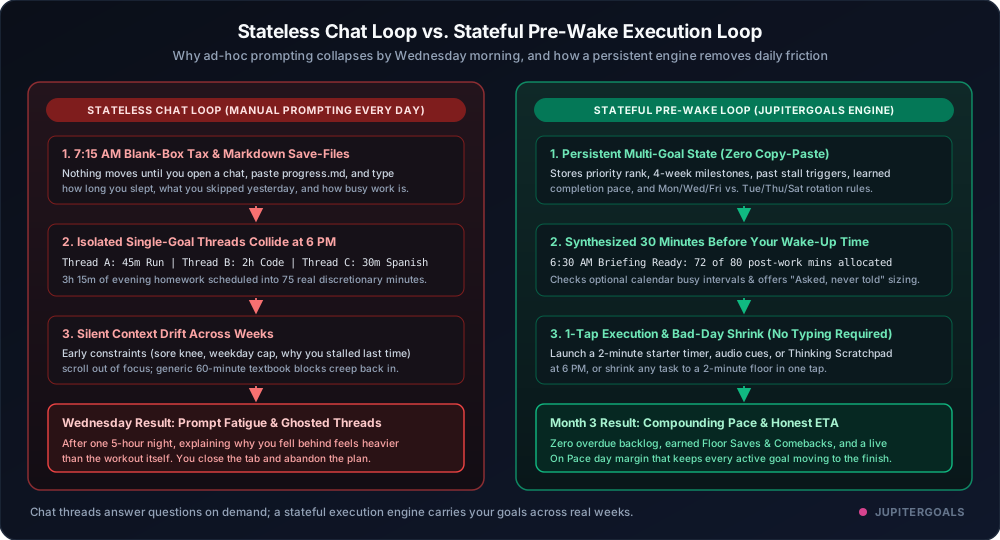
The 4 Reasons Chat Threads Break by Mid-Week
1. Prompt fatigue hits hardest when willpower is lowest
A chat window is a reactive tool: nothing happens until you initiate a turn.
On high-energy Sundays, prompting feels effortless. On a groggy Wednesday morning or at 6:15 PM after eight hours of back-to-back work, formulating a prompt to renegotiate your evening is one cognitive tax too many. When an execution system requires you to manage the coach before doing the work, you avoid both.
2. Isolated threads book 200% of your evening
Most ambitious builders are never chasing just one goal. You want to run a half marathon, ship a side project, and learn conversational Spanish at the same time.
In a chat app, each goal lives in its own isolated thread or Project folder. Your running thread assumes you are recovering on the sofa all evening; your startup thread assumes two uninterrupted hours of deep focus; your language thread asks for 30 minutes of drills. None of them share a daily time ledger, so Tuesday quietly accumulates three hours of homework inside a 75-minute post-work window.
3. Silent context drift erases your real constraints
Even inside a single long thread, conversational memory degrades in subtle ways.
Thirty turns into a goal, the specific constraint you mentioned in Week 1 (a flared Achilles tendon, a hard 90-minute weekday cap, or the exact scope-creep trap that killed your last project) drifts out of focus as older messages compress. Without a deterministic database schema backing your milestones, the model gradually slides back toward generic textbook advice.
4. The “rolling Markdown save-file” trap turns you into a clerk
Technical users inevitably try to engineer around statelessness. I tried it too: maintaining a goals-state.md file, updating completed sessions by hand every night, and pasting the updated block into fresh threads each morning.
It works for about six days. Then you miss one chaotic Thursday, your Markdown file falls out of sync with reality, and updating the save-file becomes unpaid administrative homework. You wanted a system to carry your goals; instead, you became the database middleware for a chatbot. (See Why Traditional Goal Setting Fails for why planning friction kills follow-through.)
What Works Instead: A Stateful Engine With Coaching on Top
Fixing this meant inverting the relationship between state and conversation. Instead of asking a chat log to pretend it is a planner, I built JupiterGoals as a deterministic multi-goal execution engine where the AI coach reads and updates real state in one tap.
1. Pre-wake synthesis 30 minutes before your alarm
You never prompt JupiterGoals to build today’s list. Thirty minutes before your preferred wake-up time, the engine merges your active goals into one combined morning plan, automatically rotating heavy sessions across Mon/Wed/Fri and Tue/Thu/Sat so everything fits inside 60 to 90 discretionary minutes.
2. One-tap adaptation instead of typing excuses
When sleep is short or meetings run long, you should never have to write an essay to get a realistic day. Tap once to shrink any step to its 2-minute floor (keeping secondary goals warm while your #1 priority moves), or accept a privacy-safe lighter day from optional calendar and wearable signals (asked, never told).
3. In-session tools and honest On Pace math
Good advice inside a scrolling chat disappears the moment you close the tab. In JupiterGoals, opening a step at 6 PM gives you a 1-tap 2-minute starter timer, hands-free audio pacing cues, and an auto-saved Thinking Scratchpad attached directly to that goal.
Meanwhile, there are no brittle streaks to break and zero overdue task piles. Every completed step, Floor Save, or spontaneous off-script session updates your live On Pace arrival forecast in exact days.
Keep ChatGPT for Questions. Use an Engine for Execution.
Use conversational AI for what it does best: brainstorming, debugging code, and exploring ideas on demand.
When it comes to carrying three or four meaningful goals across messy, tiring human weeks without dropping the ball, let a stateful daily engine hold the plan for you. Start 7 days free on Max, with 3 Pledges and no card required.
Related Articles
Duolingo's Streak Is Brilliant. That's Why JupiterGoals Won't Have One
Duolingo's streak and its judging owl are brilliant at getting you to open the app. They are much worse at getting you to your goal. Goodhart's law, the what-the-hell effect, and the 3 rules JupiterGoals uses instead.
Read article →Why Traditional Goal Setting Fails (And What to Do Instead)
Setting massive goals often leads to paralysis. Discover why 'tiny habits' are the secret to overcoming the overwhelm trap.
Read article →All your goals. One realistic plan.
JupiterGoals fits everything you're working toward into one plan sized to your day. Shrink or swap a step on hard days and keep moving.
Start freeNot ready to sign in? Get product updates by email →